On May 28, Thai Film Archive hosted an online live session with Apichatpong Weerasethakul to mark the 10-year anniversary of the director’s historic Palme d’Or win at Festival de Cannes with the film “Uncle Boonmee Who Can Recall His Past Lives”. In the hour-long talk, Apichatpong reflects on the Cannes triumph in 2010 and discusses at length his new film ‘Memoria’ as well as shares his thoughts on history, politics and online streaming. Read the full transcript of the interview here.
(Interviewed by Sanchai Chotirosseranee / Translation by Kong Rithdee)
We’re honoured to have with us the esteemed director and big supporter of Thai Film Archive.
A.W.: Good afternoon everyone. I actually enjoy this format because I don’t have to leave my house.
You’re usually busy travelling around. What have you been doing at home during the pandemic?
A.W.: I am on Zoom a lot, mostly about work. It’s time to explore and reflect. Luckily my house has some space, so I get to explore the area around my house, going up the hills and so on. What’s strange is I can hardly work. I feel like I’m 80 percent slower than my usual work speed. At first I tried to resist it, but then I thought I should just go with the flow.
I feel the same and sometimes it’s frustrating.
A.W.: I talked to my friends and they all find it hard to finish any work.
It’s the same for everyone.
A.W.: Maybe it’s good. It’s time to reflect.
Let’s talk about the Palme d’Or, the biggest prize you’ve ever received. How much did it affect your career?
A.W.: It’s the biggest prize on the biggest stage. Many filmmakers I respect have also won it. I was up there on the stage where everyone could see me, so it means people have heard me and I don’t have to make them listen to me. The award made me more humble. And you know I don’t like being at the centre of things. I don’t have to shout because people can hear me.
Because from that stage, your voice can be heard?
A.W.: Yes, it’s where people can hear what I have to say.

PHOTO: AP
Let’s talk about Memoria and your shoot in Colombia.
A.W.: There are two reasons why I shot in Colombia. First, I was fed up with working in Thailand because I can’t make a film that says what I really want. I want to make a film that doesn’t need symbolism or cinematic metaphors. I want to make a straightforward film. The non-democratic-atmosphere of the past many years makes it difficult. Second, I wanted to set myself a challenge. When I shot Cemetery of Splendour, there was an English-speaking character, the husband of Aunt Jane. It was difficult to direct him and I felt that it must be hard to direct a film in another language. That’s why I went to Colombia, to prove if it was really like that. But once I was there, I had a lot of help. The most important person is Boat [Sompot, his A.D.] who has been working with me for a long time. And also Sayombhu, the cinematographer, who has been working with me for years goo. Also the Colombian crew were fantastic. I love them like my own family. It shows that filmmaking requires a universal language, apart from the speaking language. It’s also about feeling and teamwork. I trusted them and it became even easier than shooting in Thailand because I don’t have to focus on other things except the acting. The most challenging thing is the weather. Bogota is in a valley, so in one day you have sunshine and rain and wind, everything. It was very challenging in terms of costume and continuity. We had to be flexible and alert. This is what I enjoy about shooting on location and not in the studio. When I brought the footage to Lee [the editor] and Rit [sound designer], all the pieces came together. It lit a fire in me and I would love to do it again. It’s challenging and I’ve met a new family who has the same idea about filmmaking.
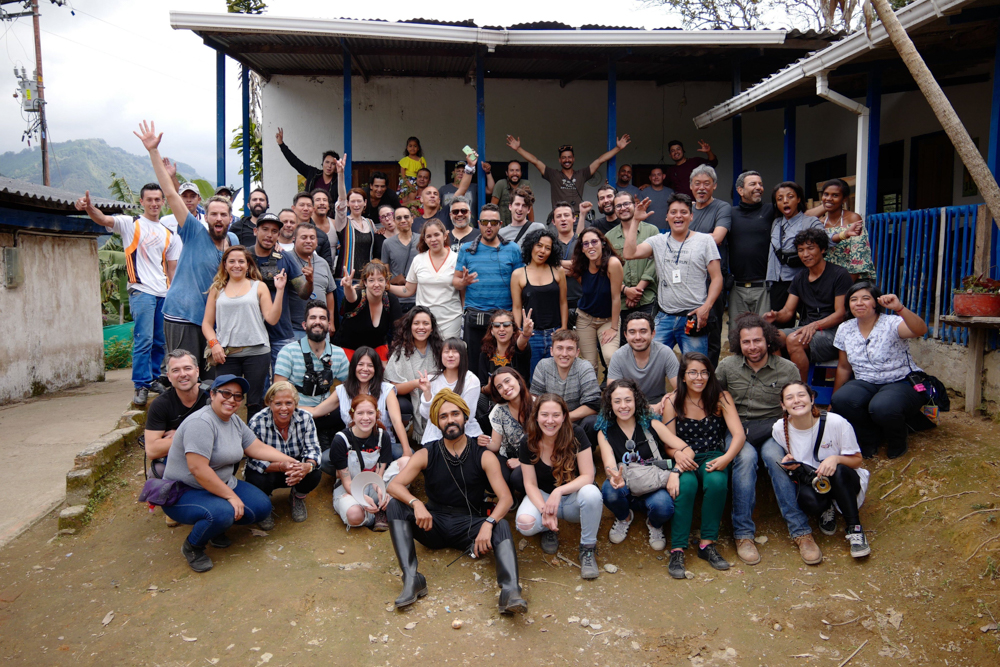
PHOTO: Twitter @kickthemachine
Talking about rain, I heard that Aunt Jane introduced you to the rain-stopping ritual. Is there the same ritual in Colombia to make sure a shoot can continue?
A.W.: In fact, we should introduce our rain-stopping ritual to them. In Thailand how do we do it? A virgin has to stick lemongrass into the ground? Aunt Jane wasn’t qualified anyway! But no, we don’t perform any ritual before the shoot, not in Thailand because it’s a waste of money. And there’s no such thing in Colombia either. But you have to ask Sompot, he knows everything that’s going on. Many times I only learnt about some problems later because he didn’t tell me.
Like, they were performing a rite tos ome deity without telling you!
A.W.: Even a few days ago, in post-production, there was another issue that came to the producer. That’s why I love my producers because they’ll always protect me.
Maybe because there are lots of problems because you’ve left your comfort zone. So they feel they have to protect you.
A.W.: This is a comfort zone that I should have taken a long time ago.
What about your next project? Would you go back to Colombia?
A.W.: I still don’t know. But because of Covid-19 I’ve had time to be with myself and to read many books that I had left unfinished. I like reading scientific articles and I’m now interested in marine life. I’m fascinated by their intelligence and “animal technology”. I’m especially interested in octopus and its family. In Thai, we have only one word for cuttlefish, squid and octopus – we call them “ink fish”. Maybe my next film will be about that.
You’ll shoot underwater?
A.W.: Under the water or in a research centre, I don’t know. Like I went to Colombia because I’m interested in the culture, the people. With marine life, I want to force myself to be in the environment that I’m interested in.
Maybe the main character will be a diver? Anyway, shooting underwater is difficult.
A.W.: Yes, I’ll need a lot of special effects. It’ll be challenging.
Let’s go back the time of Tropical Malady. Back then you said you were a “monster” [like the Thai title of the film] because you were still hot-headed and aggressive. You later practiced meditation to calm yourself down. Do you still do that?
A.W.: Yes, I still meditate, especially lately.
The situation allows more time to reflect?
A.W.: I become used to it. On the one hand we try to understand how a lot of people suffer [because of the pandemic]. On the other, we want to feel peaceful. It’s hard to say because we’re not suffering like many people.
You’re known as a filmmaker with a distinctive signature. But when you meditate and try to minimize your “self” and your ego, does that affect the way you create you work?
A.W.: It’s hard to say. When I was “a monster”, back in 2003, there were a lot of problems at the shoot, the night shoot, which I disliked, and the financial constraint. I was almost blacklisted by the camera company. I was under a lot of stress. This affected my work, it plunged me into a sort of dark energy. It was sort seductive. Tropical Malady is a diary of darkness. Then I healed myself and I meditated. The next film, Syndromes and a Century, is a diary of light, before it was censored. Making personal films is fascinating. It’s not about having signature, but about expressing yourself, your sentiment in a film. As you grow older your world view changes, and your idea about cinema changes. I’m not as stressful as before. I enjoy exploring and travelling. I’m more ready to compromise and to adjust. To feel attached to “the signature” is more frustrating. It’s not a good thing. Like in the editing, which is how you express yourself. I tried in Memoria to edit the film in a different way, but it’s hard because I shot it like I used to shoot all my films. So it’s important that I diversify into short films, visual art and photography. That’s why I have a variety in my artistic expression.
You’ve made films on 8mm, 16mm, 35mm and digital. What’s your thought on film materials?
A.W.: It’s the texture, the personality of a film, the first thing people will notice. I shot Cemetery of Splendour in digital, so did many of my shorts, and it was flexible. But if we talk about beauty, personally I prefer film. I grew up with film, my memory of cinema is film. Maybe it’s different for the new generation. My representation of reality may be different from a younger generation. Maybe it’s different for the new generation, which prefers another kind of realistic quality. Nothing is right or wrong. I have to adjust myself to Dew, the colour-grading guy who’s worked with me in many films, and who I much admire. In the new film, I did a lot of adjustments, but the essence of each image is the same as how I shot it. The latitude between light and darkness is very wide in this film. Another important point is workflow. A set that works on film is different from a set that works with digital. A film set is more focused, more like a sacred ritual. Memoria was shot on 35mm and I had to think a lot about continuity and quantity of film to use. Each roll runs for 14 minutes 50 seconds, and I have to think about how I’ll use it in long takes. So I had to concentrate, and I enjoyed that kind of stress. It’s great to work with Sayombhu. We started out together in 2001, in Blissfully Yours. I’ve seen him getting better and better, and he’s now a master! It’s great because we grew up together professionally. Our philosophies about image are the same. For instance, we both like natural light. In Memoria, the final scene is a very long take that goes on until sunset. It’s like a test on how to handle that challenge working with film, because you can’t see right away what you’re shooting.
Usually you work with the same people. But in Colombia, you have to work with a new crew, how did you tune into them?
A.W.: Filmmaking uses a universal language. We worked as a team and I had to start many things from scratch. I couldn’t take what I used to work with in Thailand. Of course I like ordinary things. Say, Aunt Jane is an image of “ordinary”. But what’s “ordinary” in Colombia? I had to get used to it. The crew in Colombia said they watched my films since they were students, so I realised how old I have become! But at the same time it’s not hard because my style hasn’t become that different.
They’re familiar with your film.
A.W.: Yes.
This is the first time Aunt Jane is not in your film.
A.W.: Yes, and we have Tilda. The challenge is to make Tilda look ordinary because she’s everything but.

PHOTO: Sandro Kopp
During the lockdown, have you watched any online movies?
A.W.: Nothing. Sorry, I don’t like watching movies.
People are debating if streamed movies are the same as tradition movies in cinemas. Will this affect your approach to filmmaking, now that some people have become used to streaming that they will no longer want to go to the theatres?
A.W.: Streaming has been around for a while and it has brought more variety. But I don’t think I’ll have to adjust myself to that platform. What’s more exciting is VR. That requires you to overhaul your way of conceptualizing a work. Anyway, streaming has made the experience of going to the cinema even more precious. It will make people appreciate the beauty of sitting in the dark room, like in a cave with the light enveloping you, like when you’re dreaming. You can’t experience this with streaming or on TV screen. What I do is design my film for the cinematic experience. It’s not my film anymore when you watch it on a laptop or TV screen.
You wrote an essay for Filmkrant imagining how people would become so used to slow cinema due to the heightened awareness brought by the lockdown and Covid-19. Can you talk about slow cinema and if you’ll continue making films in that speed?
A.W.: My films are not slow. If they were slow, I wouldn’t have made them. I think they have the right rhythm for me. What I wrote is an observation from my own experience that I have become used to the slow passage of time and I’m aware of the detail of things around me. So I thought maybe if other people feel the same way, they might demand another concept of time in movies. But it’s just my own fantasy. As I said, I don’t watch many films. I listen to music and observe the reality. I watch my dreams more than I watch films
Has Covid-19 inspired you to create other works?
A.W.: Maybe visual art. Filmmaking requires a team, so when I don’t have a team it’s not possible.
With visual art I can start working on it myself. I’m writing scripts and I’m preparing a performance as a follow-up to Memoria. It’s about sleeping and a journey and a sound imprisoned inside the head. And maybe I’ll put in some marine animals.
I was thinking about your sleep project at Rotterdam. Falling asleep while watching TV movies is normal, but falling asleep in a cinema?
A.W.: Me, I fall asleep in a cinema.
Another Covid-related question. What should be the role of cinema and art during this time of crisis?
A.W.: I think art makes people stop and think. It stops people in another dimension, even for a fraction of a minute or a second. In that time we have no past, no future, no self. It’s like meditation. When I look at an artwork that communicates with me, it makes me stop worrying. I can’t explain it. But It stops the madness and the fear that’s going on during this time of Covid-19.
When I look at an artwork that communicates with me, it makes me stop worrying. It stops the madness that’s going around me during this time of Covid-19. Would you have any advice on young artists or filmmakers on how to deal with it?
A.W.: Just go ahead and do it, don’t hesitate. Start working now. I think writing or sketching is good enough. If you hesitate and fear that what you’re making won’t become a masterpiece, then you’ll never get to start. But still, you shouldn’t run, but walk. That’s what Ben Anderson taught me about creative process. Another important thing is location. Put yourself in a location. Maybe it’s not possible now but you can still do a research. Every place has its own time, its own rhythm, and how we connect our rhythm to that of the place will bring about a child born of the two times. And to know about the politics of each place is to respect that place. Even though you're making a horror film or a comedy and not a political film, what you make will still reflect that. This is challenging for me and for other Thai filmmakers as well.
Politics and Covid...
A.W.: It’s strange that we live in a country that has no political stability at all, but we don’t have any film about the subject. It’s not right. I put my hope with young filmmakers.
A question from the audience. What have you been reading lately?
A.W.: I’ve read many books at once. During breakfast I read the autobiography of Oliver Sacks, which I find fascinating. I’ve been catching up on Mishima, the four books, and scientific articles, including about octopi.
A popular question: Any favourite film you would recommend?
A.W.: Oh, I haven’t watched anything in a long time. Let me tell about a film I want to watch and recommend. I want to see Manta Ray [a Thai film by Putthipong Aroonpheng].
The DVD of Manta Ray is out, you can look it up. An interesting film.
A.W.: and Concrete Clouds.
Concrete Clouds has never come out as DVD. People ask Thai Film Archive all the time about the film. It’s a film that captures the situation after the 1997 financial crisis.
A.W.: Oh, and Are We There Yet? [a former name of Railway Sleepers; Thai documentary film by Sompot Chidgasornpongse]
A question from the audience: Back in Tropical Malady, your soldier character come across as positive. Would you have changed that now?
A.W.: It’s not positive. I look at it as a symbolic character more than a political one. The soldier is a hunter and a prey [in that film]. And I’m interested in the uniform. It’s all connected to a historical episode, I wasn’t saying it’s positive or negative. I want to encourage people to think about what happens outside what’s presented in textbooks, especially in the Northeast.

Photo: Kick the Machine
Maybe it’s time to revisit the film and see it’s not about good or bad soldiers, but something that needs to be interpreted.
A.W.: The negative part is worth talking about, because there are so many. This is why I’m still motivated. I hope young filmmakers will feel even more fired up than me. What the military has done is serious and filmmakers have to reflect that. It’s about finding out the truth and fighting what has oppressed you. There’s information that is used to oppress us for decades. It’s hard but it’s challenging.
From the audience. You talked about wanting to shoot in Mexico, are you still up for it?
A.W.: I would love to. I have heard about an underwater cave that existed after a meteor crash. Hearing that lights up my imagination.
The person who asked the question has lived in Mexico for 16 years and sent a list of locations.
A.W.: Thank you.
Next question…
A.W.: I see question from chat about the concept of time. The concept of time isn’t something that concerns filmmaking. It’s about how we perceive the world. It sounds simple but it’s complicated. The time in Buddhism is a contrast to the idea of filmmaking, which is about clinging on to a memory that we have created. It’s not “the present”. I’m interested in the structure of film and if it can hold the audience in the present. Sitting in a theatre watching a film is to watch an illusion, a memory of someone else. While you’re watching a film, will you be conscious of your own breath? This is what intrigues me, because online movies today make people forget the present. They drive you forward very fast through the editing and sound design. It makes you oblivious to the present. I think there can be movies that counter that approach. Movies that make people aware and not lost.
In your article, it seems like the pandemic has made people aware of their moments and concentrate on a slow, still movie. Is that what you’re trying to say?
A.W.: I try to be sarcastic, sort of. Personal movies are marginalised anyway. But sometimes when this fringe interest becomes more popular, like organic food or vegetarianism, suddenly it becomes so expensive and expanding like a virus. I mean it as a sarcasm because there’s no way [personal movies] will become mainstream. But it’s more interesting that way, because to be ignored means it has a chip on its shoulder, and that’s worth exploring.
From the audience. What do you think about Northeastern culture and its growing popularity online?
A.W.: I think everything that breaks away from the centre, be it the North or Northeast, if it dilutes the control from Bangkok or what is defined as “normal”, that’s a good thing. It’s something to be proud of. Not just because I was born there but it’s about equality. It tells the central power to stop patronising us. It’s about individualism. When we go to school and have to use the central dialect, it means the loss of so many regional dialects. It’s a shame. Now on Twitter people use a lot of profanity. For me it’s an attempt to create a new balance. It rejects the old order and the hierarchy of language.
It’s great that new technology has become a channel for subculture or marginalised culture. Something that was ignored or voiceless is being heard again.
A.W.: Yes, it’s still marginalised, a “mistress’ child”. Like it’s not at the same level.
People analyse your films as an attempt to talk about these people on the fringe, people with no voice.
A.W.: Yes.
Will Memoria be more accessible? When do you plan to release it?
A.W.: It’s not complete yet. But as it is now, it will be more straightforward. I’m not sure if it’ll be “easy”. That depends on your sense of time, it needs you to adjust your time. It’s not easy, but let’s say it’s simple.
And still a film that relies on being “ordinary”.
A.W.: Yes.
About the release date, it’s not certain because of the situation. There’s a question about the future of cinema and filmmaking in the post-pandemic time.
A.W.: I just talked to my friend in Canada [Connor Jessup]. He said everything on set has to be adjusted. Like how each department works, how to film a scene. Like a set decorator has to finish his work then leave the set. No crowding around. Like we’re on Zoom now. We depend on image technology and cinema is about making image. So a technology that connects one person with another person on a screen may arrive in the future. That’s just an imagination. What may really happen is that we will have more personal movies. People who stay home, they are not professionals, but they can try the art of moving image made possible by technology.
You often talk about dreams. What were some of your recent dreams?
A.W.: It’s weird because I didn’t sleep well lately but I dreamt a lot. Last night I dreamt that I went to a restaurant in Thailand. It was a small wooden place. I opened the door and saw a vast space with a big pond and lots of tables. But it’s evening and there were no customers, or maybe it’s because of Covid. I talked to the owner and he cooked me something. I’m sorry, it’s a very undramatic dream. But the other day I dreamt I killed someone and I had to clean the blood from a blanket. Two Mexicans, a man and a woman, had to help me.
I’m jealous I didn’t have that kind of dream for a long time.
A.W.: Really. I dream a lot, I draw what I dream sometimes.
From the audience, which films or directors are your influences?
A.W.: A mix of many people. Andy Warhol. Maya Deren, the experimental filmmaker. Tsai Ming-liang. I like filmmakers who blend art and personal stories. As I said before, these artists make films that stop time, that confront us. They make us ask questions and forget ourselves. Especially Andy Warhol. It’s not just his art but how he connected with his audience.
Warhol’s Sleep and Empire State?
A.W.: Yes, and think about the time when he made those. It’s strange. No one ever thought about it before and he made it so visible.
This question is from Khon Kaen. Is there any story or memory about Khon Kaen you would like to tell?
A.W.: I could do many more. I like Kaen Nakorn Park... A lot of stories from Khon Kaen. Recently I worked with a man called Bank, a morlam folk singer. He’s a genius who should be promoted. Bank studied at Khon Kaen University and lives there. A brilliant morlam artist. I wish I could make a documentary with him or collaborate with him in some ways. Khon Kaen also has this monument of Sarit Thanarat [a military dictator from the 1960s]. I’m amazed why they haven’t torn it down already. We know from history that, well, he might develop the region and the country, which was his job anyway, but he was also ruthless and hugely corrupt. So why do we still worship his statue? I’m not okay with this and want someone to explain it to me. Do Khon Kaen people ask this question, or do they just see the monument as a traffic landmark without any knowledge of its history?
You wish to know how local people regard this monument?
A.W.: Yes, I want to show that there’s a dark side to it. The monument and the bas-relief glorify him like a god, but we have to ask if this is right.

PHOTO: Ten Years Thailand (2018)
Another related question: Any thought on making a film about the erasure of the 1932 Revolution?
A.W.: Yes, we know that this is an orchestrated movement to alter the collective memory. The new generation has to ask questions, without resorting to violence. We can have a conversation in peace and love. I believe we have peace and love of humanity inside. We’re not barbaric creatures. We should talk with reason and information. But when we don’t have a platform to talk about it, we are forced into a situation of conflict.
It’s also a job of filmmakers and artists to record what happens. A question about books and your favourite authors.
A.W.: I like Mishima. And Oliver Sacks. Actually, a lot. Mostly Japanese, like Tanizaki and Kawabata. I like classical writers who write with flourishes.
There’s a question about your “Almost Fiction” in Chiang Mai.
A.W.: It’s about military uniform. I live next to an army base but it’s like a mysterious place where we can never know what’s happing inside. We need to reform the army, the allocation of resources, everything. Especially now that we’re in a tight economic situation. We need to reform all organisations that consume a lot of resources. “Almost Fiction” is a photo exhibition and I play with a blinding light on the faces of the soldiers. I don’t want to say what it means but you’re welcome to interpret. Another set is called “Insomnia”. It consists of images that I wish to have included in my films but didn’t. So I restaged those scenes and lined them up to make an imaginary film.
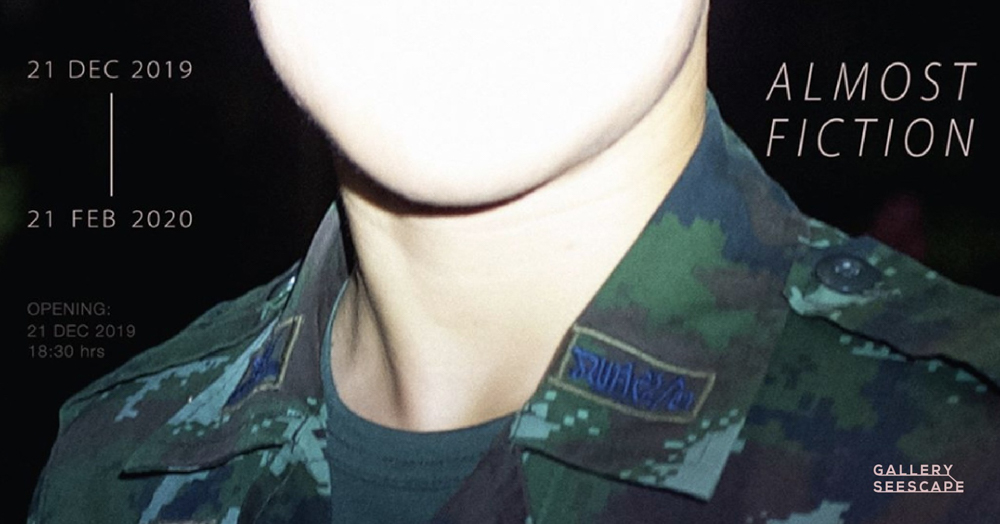
PHOTO: Gallery Seescape
Someone asks you about your use of oblique narrative and open-ended ending that allows rooms for interpretation. Why is that?
A.W.: It creates space. It’s freedom. There’s nothing right or wrong. We grew up in schools in taught us to believe that it’s either right or wrong, black or white, yellow or red. It’s got to be something. But life is more complicated. To open up the space is like letting an artwork live its own life. Then art is complicated, like a person’s life. A complicated person is more attractive. That kind of artwork is more precious to me.
What do you think about SpaceX’s launch that’s happening this Saturday?
A.W.: I’m excited even though I haven’t followed the news. It’s like dream. Like we can defy everything, gravity and things that used to seem impossible. It’s pushing humanity forward. Aerospace technology has a great impact on many tools we’re using today, like your phone.
Are you interested in making a film about Thai-Lao relationship?
A.W.: I’ve never been to Laos in a long time. But I feel that if the geography of Thailand is hard for filmmakers, it’s even harder in Laos. The Thai-Laos relationship is interesting because we’re like a family. Aunt Jane for instance. In her memory Thailand and Laos are the same. But they were split by politics. Aunt Jane’s father is in Laos, she doesn’t know if he’s still alive or not. This is a family divided by politics. Is it possible to reconnect the feelings? I think the person who asks this question should start making this film!
Last question, Thai people have a strange relationship with history and with memory. We tend to forget serious events, like protests of dictatorial rules. This creates an endless cycle of democracy, violence and dictatorship. What’s your thought on this?
A.W.: Ninety years after we have become constitutional monarchy, actually it’s 80--plus years, it’s not that long and we still have become a real democracy. There are always power struggles which leave out the people. In our generation, we were taught to respect the power, even in art, architecture, language, or how we dress. The power and the old rules have repressed us, so we though society is supposed to be like that. Another factor is Buddhism. Thai Buddhism is a mix of Hinduism, animism and belief in spirits. This is a construction of a hierarchy, spiritual hierarchy, not just factional power. The teaching about karma makes people fear the power they cannot see. Then they all come together in our textbooks. We grew up and we were told to become meek, submissive people, and that can be exploited politically. We don’t ask questions. We surrender and think that the lines between each class have long existed. And we shouldn’t desire to overcome them, and they’ll keep us down and tell us it’s great enough where we are. We have to understand how we have been shaped as human beings. It’s not that we have short-term memories. It’s because we don’t ask questions and don’t know we have rights. But it’s changed in this generation. They no longer want to be repressed by the power. And this we have to support. We have to move together regardless on which side you stand because all of us want freedom.
We have 10 years between us but we grew up with the same textbooks that have hardly changed. But technology today allows kids to see things beyond their textbooks.
A.W.: It’s very powerful [the system]. I saw a documentary about a North Korean woman who had an eye surgery. The first thing this old lady did when she could see everything again was to run toward the picture of her leader and paid respect to it to thank him for making her see again. I thought, is this real? But when I looked back at myself, I knew it’s real What they put in the children’s heads is powerful. That’s why I’m surprised to see some friends who accept this as normal, though they are highly educated. People with Ph.D. still refuse to open up and consider how politics is in every moment of our lives. We have to remember how powerful the message is and why it’s so hard to resist.